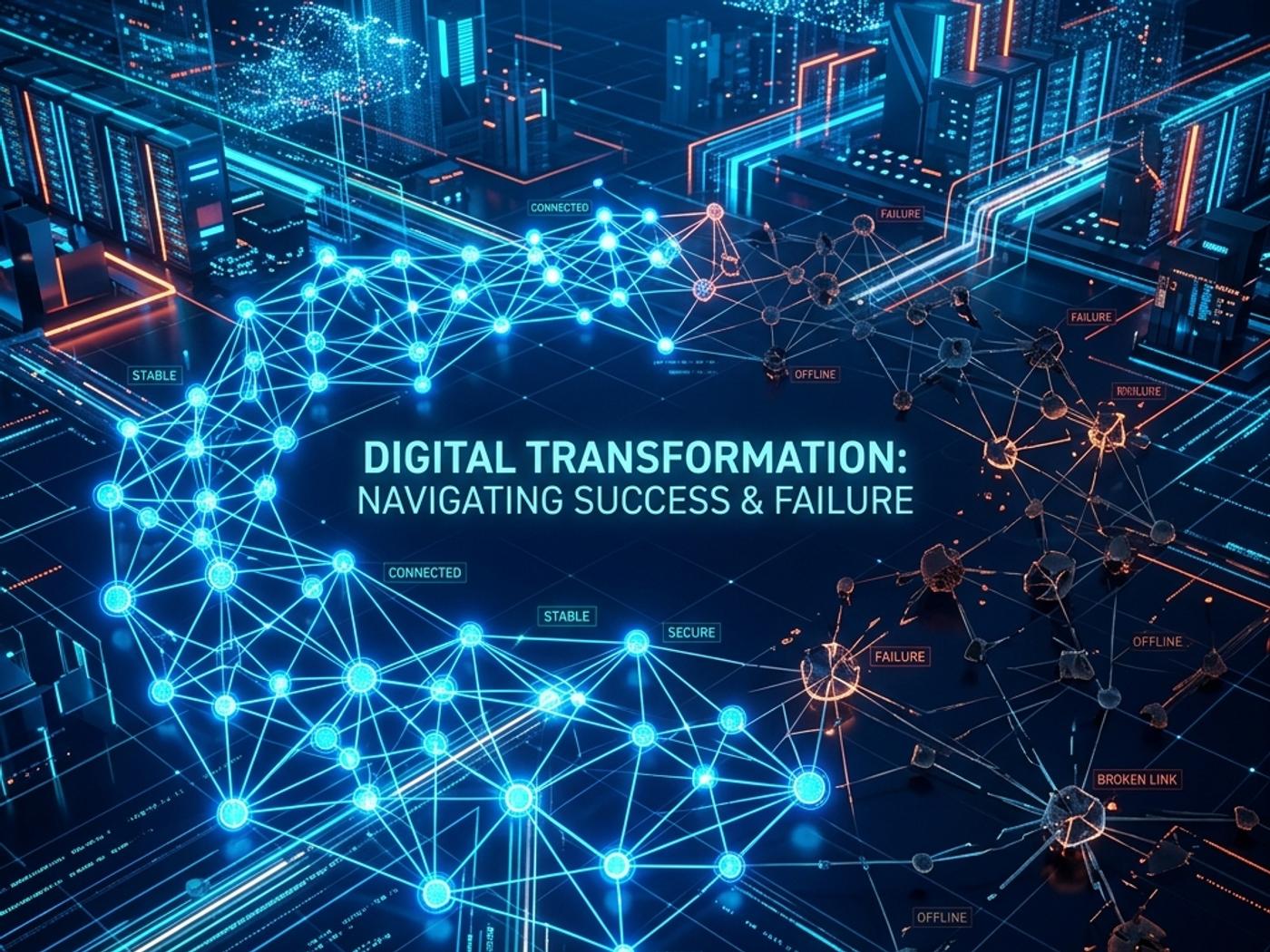
The failure rate for digital transformation has been around 70% for a decade. That number has not meaningfully improved despite better tools, better frameworks, and more investment. The consistent reason is not technology. Here is what actually separates the projects that deliver from the ones that quietly get wound down.
The 70% failure rate for digital transformation has been cited so many times it has become background noise. Everyone knows the number. Very few organizations have actually used it to change how they approach transformation.
The number has also not improved. Per McKinsey research, the failure rate in 2024 is roughly what it was in 2014. Ten years, massive investment growth, significantly better technology, and the same proportion of programs failing to achieve their stated objectives.
If the problem were technology, it would have improved by now. The technology is dramatically better. The failure rate is about the same.
The problem is organizational. And organizational problems do not get solved by better software.
The Five Failure Patterns That Appear Consistently
After working through transformation programs at organizations like Adobe and Zendesk - and watching a significant number of client programs up close - the failure modes are not random. The same patterns appear across industries and company sizes.
The project is solving the wrong problem. This is the most common failure mode and the hardest to diagnose, because the program can be executing well against a problem that is not actually the constraint on the business.
The clearest version: an organization identifies "lack of customer data" as the problem, builds a customer data platform over eighteen months, and discovers that the constraint was not data access - it was the analytical capability to use the data that already existed. The new platform provides more data to teams that were not using the data they had.
Solving the wrong problem with high execution quality still produces the wrong outcome. This is a key reason why a digital transformation strategy misses the point.
The transformation is funded but not prioritized. Budget is not prioritization. Many organizations fund transformation programs and then expect the transformation to happen alongside everything else the organization is already doing - without creating capacity for the transformation work or protecting it from operational demands.
The program that is funded but not prioritized gets the budget and not the time, attention, and organizational focus the work requires. It executes in the gaps between other things, loses key people to operational demands at critical moments, and consistently produces less than it promised.
The governance structure is wrong. Transformation programs are typically governed by a steering committee that meets monthly, reviews status reports, and makes decisions between meetings that the program then either executes or waits on.
Monthly governance for a program that needs weekly decisions is not governance - it is delay with a formal structure. The programs that move well have decision-making authority closer to the work, a clear escalation path for decisions that genuinely need senior input, and a cadence that matches the pace the work requires.
The business case is not connected to the execution. The business case that justifies the transformation investment describes specific outcomes: cost reduction, revenue growth, customer satisfaction improvement. The program plan that executes the transformation is built around milestones, workstreams, and deliverables.
These two documents often have almost no relationship to each other. The program delivers its milestones and nobody asks whether the milestones are producing the outcomes the business case promised. The link between "what we are building" and "what we said this would produce" is lost in the transition from justification to execution.
The integration layer is underestimated. Every meaningful transformation requires integrating new capabilities with existing systems, processes, and data. The integration work is consistently underestimated - in time, cost, and complexity.
The vendor demo shows the new system working cleanly with itself. The implementation involves connecting that system to seven legacy systems, two of which are underdocumented, one of which the vendor has never integrated with before, and all of which are being managed by teams with limited bandwidth for integration work. The integration layer is where a large proportion of transformation budgets disappear.
What the Programs That Succeed Do Differently
They spend more time on problem definition than most organizations think is warranted. The transformation that takes four weeks to clearly articulate the specific problem it is solving, the specific change that would indicate success, and the specific reasons the current state is producing the current results - before touching technology or process design - consistently outperforms the transformation that moves to solution design in week one.
This is not comfortable. There is organizational pressure to show momentum, and problem definition looks like delay. It is not - it is the work that determines whether everything that follows is pointed at the right target.
They start smaller than the ambition. The organizations that succeed at scale have almost always succeeded first in a bounded environment. One function, one geography, one product line - where the transformation can produce genuine results, build organizational credibility, and generate the learning the larger deployment needs.
The pilot is not a delay to full deployment. The pilot is the proof that makes full deployment possible.
They connect program milestones to business outcomes explicitly. Every major milestone in the program has a clear line to a business metric. "Data platform Phase 1 complete" is connected to "which business outcomes become possible at Phase 1 that were not possible before, and what is our plan to capture them."
The program that does not draw this line will deliver its technical milestones and produce uncertainty about whether it worked.
They treat the change management work as load-bearing, not supplementary. The most successful transformation programs I have seen treat the organizational change work - communications, training, role transitions, behavioral modeling - as a first-class workstream with real resources, not as something that happens on the side while the technology work proceeds. The change management work is not decoration. It is the mechanism by which the technology investment produces business results. Without it, you quickly see why the textbook approach to change management keeps failing.
The One Thing Most Assessments Miss
Most post-mortems on failed transformation programs focus on execution issues: timeline slippage, budget overruns, vendor performance, technical challenges.
These are real. They are also usually symptoms rather than causes.
The underlying cause, in most of the failed programs I have observed, is that the organization never made a genuine decision to transform. It made a decision to fund a transformation program. Those are different things.
Funding a transformation program is an investment decision. Deciding to transform is an organizational commitment - to changing how the organization operates, at real cost to the people who have to change. A business transformation roadmap that survives contact with reality accounts for this difference.
Many organizations make the investment decision without making the organizational commitment. The funding flows, the program launches, the governance structure forms.
And the organization continues, beneath all of that, to prefer its current way of operating.
The technology gets deployed. The training gets completed. The adoption metrics look acceptable.
And the organization is doing the new things while continuing to do the old things, because nobody ever made a genuine commitment to stop doing the old things.