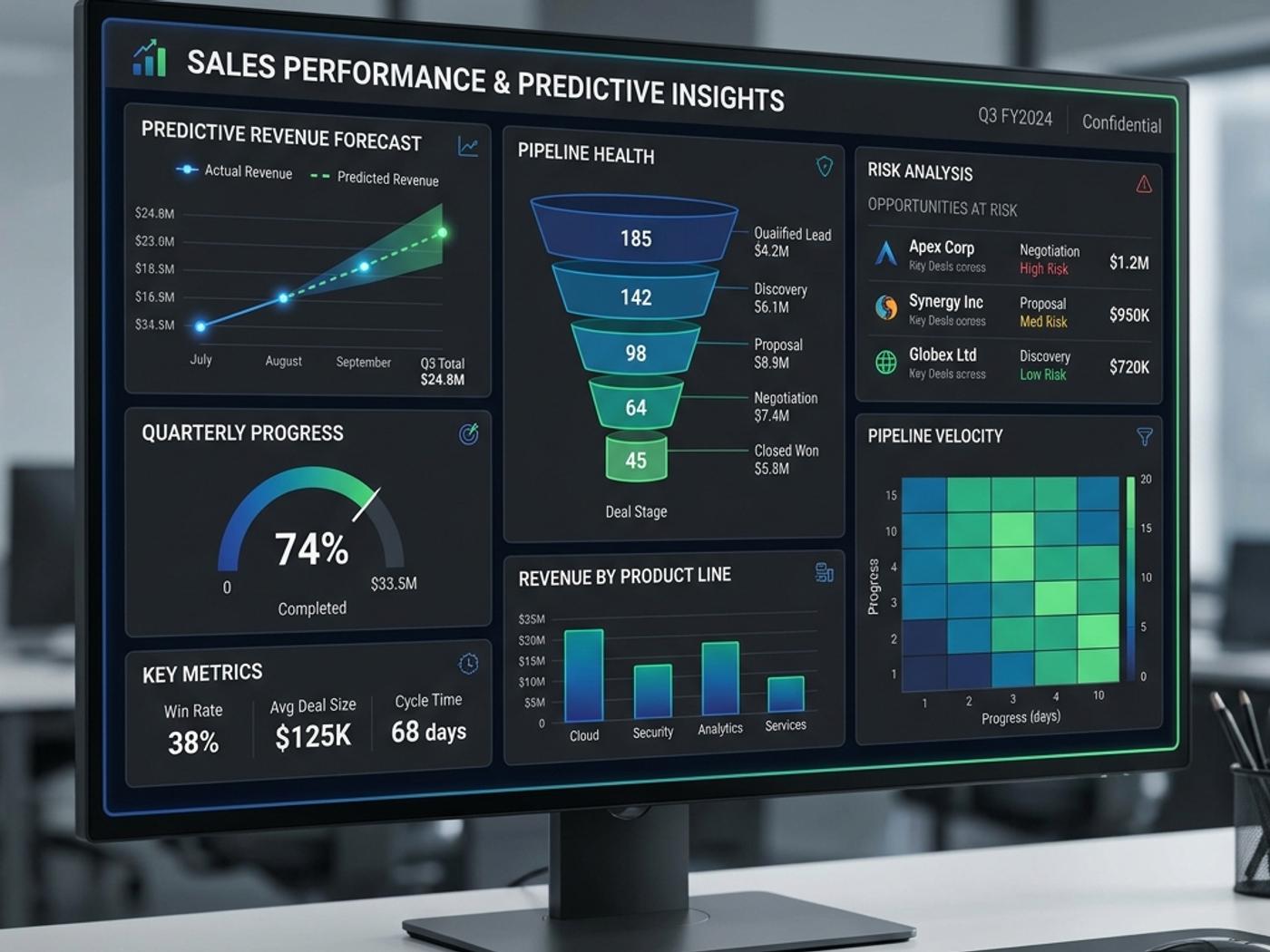
If you multiply a $100k deal by a 50% probability, you forecast $50k. But at the end of the quarter, you never close $50k. It's time to build a true predictive revenue engine.
I remember sitting in a Q4 revenue review at a previous SaaS company. The VP of Sales projected a $2.4M quarter. The spreadsheet looked flawless. The CRM was completely green.
He was using a standard weighted pipeline. He had $4.8M in Stage 3, and historically, Stage 3 converted at 50%. The math said we were safe.
Three weeks later, one massive enterprise deal stalled in procurement, and two others went totally dark. We missed the quarter by a million dollars. The VP lost his job six months later.
That was the moment I realized that if you are multiplying a $100k deal by a 50% probability, you are forecasting fiction. At the end of the quarter, you will never close $50k. You will close $100k, or you will close zero.
A weighted pipeline doesn't tell you what will happen. It tells you the mathematical average of a thousand parallel universes. But you don't live in a thousand universes. You live in this one. And in this one, relying on single-point averages for complex B2B sales cycles is exactly how revenue leaders get fired.
The Illusion of Pipeline Health
In 2026, the focus has shifted from having a "full pipeline" to having a "healthy pipeline."
Forrester's research on sales forecasting confirms this shift: revenue leaders need to stop asking salespeople to estimate subjective probabilities and move toward predictability.
But most B2B sales pipelines are inherently unpredictable. You aren't selling ten thousand $10 widgets. You are selling twenty $150k enterprise contracts. When deal volume is low and deal value is high, averages break down. If two massive "commit" deals slip to the next quarter, your 70% weighted forecast completely collapses.
The problem isn't just that sales reps have "happy ears." The problem is that standard CRM forecasting tools treat pipeline risk as a static percentage rather than a dynamic range of possibilities.
Revenue leaders don't need a single, magical number. They need a predictive revenue engine that exposes their vulnerability to chaos.
The Math Behind Pipeline Risk Analysis
Monte Carlo simulation sounds like quantitative finance jargon, but it is the exact engine running under the hood of the most elite B2B revenue organizations today.
Gartner's insights on sales pipeline management highlight probabilistic forecasting and structured data as the primary differentiator for high-performing RevOps teams.
Instead of taking one average (like a weighted pipeline), this methodology runs your current pipeline through thousands of randomized trials.
It takes every single deal, looks at its specific win probability, deal value, and time-in-stage, and simulates the end of the quarter 10,000 times.
- In 2,000 simulations, your whales slip, and you miss target.
- In 5,000 simulations, you hit your baseline commit.
- In 3,000 simulations, everything breaks right, and you crush your quota.
The Signals Revenue Leaders Actually Need
When you run your pipeline through this kind of predictive engine, you stop asking "What is our forecast?" and start detecting the "hidden leaks" that ruin quarters:
1. The "Happy Ears" Trap
If your simulation shows you need an 80% win rate across your late-stage pipeline to hit target, but your historical win rate is 35%, your reps have happy ears. The math proves you do not have enough pipeline coverage to survive normal churn.
2. Time Decay Risk
Standard CRM reports don't care if a deal has been stuck in Stage 4 for 90 days. A real predictive engine penalizes stagnant deals. It forces the truth to the surface: deals that don't move, don't close.
3. The Whale Dependency
If your simulation reveals that hitting quota relies entirely on two massive enterprise deals closing in the last week of the month, you are not forecasting. You are gambling.
Stop Guessing. Start Simulating.
The reason most sales teams still use weighted averages is that running 10,000 probabilistic simulations used to require a data science team or an incredibly expensive piece of enterprise software.
Not anymore.
We built a free, zero-friction Predictive Sales Simulator specifically for B2B revenue leaders.
You don't need to connect your CRM or expose your proprietary customer data. You simply plug in your current pipeline metrics, define your targets, and our engine runs the math right in your browser.
It won't just give you a number. It will hand you a comprehensive Remediation Playbook—highlighting your exact pipeline risk profile, exposing your "Happy Ears," and telling you exactly how much extra pipeline you need to generate to insulate yourself from a bad month.
Stop forecasting fiction. Go run your pipeline through the simulator right now, and find out what your quarter actually looks like.