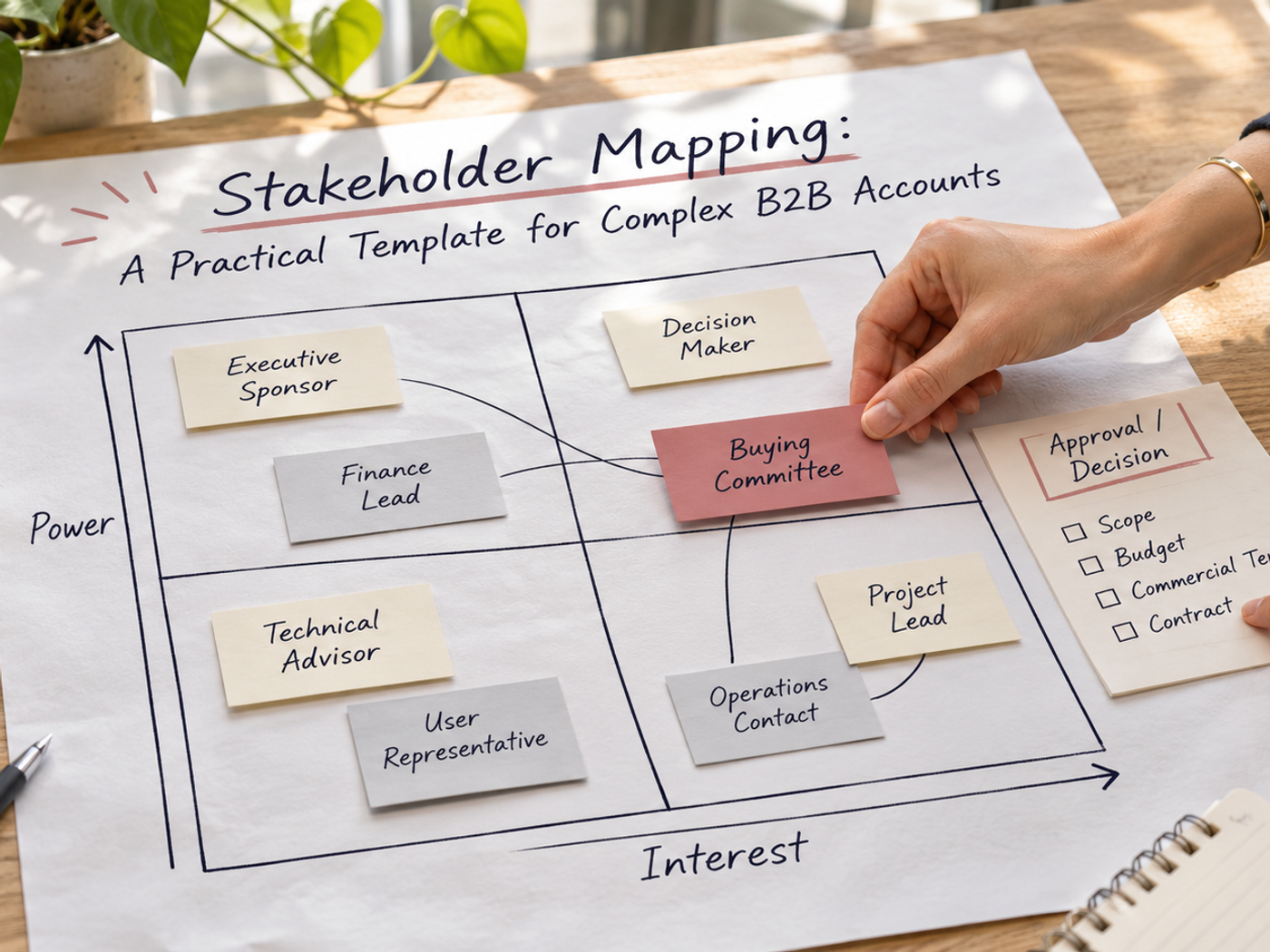
A practical stakeholder map connects each business decision to the people who can approve, influence or carry it out. Here is my approach, with a B2B example and a free worksheet.
What is stakeholder mapping?
Stakeholder mapping identifies the people affected by a decision and the people who can influence it, then uses that information to plan their involvement. For B2B accounts, my approach connects a specific decision with the authority, evidence and practical work needed to reach it.
A customer may support an expansion while finance is still assessing the return and operations is trying to understand the extra workload. All three positions can be reasonable. An account plan needs to make those dependencies visible before a commitment is made.
I have included a free stakeholder-mapping worksheet for Excel or Google Sheets. It is a CSV file with suggested roles and blank fields to complete. It opens without macros and requires no sign-up.
Start with the decision the map needs to support
For an existing account, the question might be whether to renew, expand into another business unit or approve a change to how work gets done. Each decision can involve different people. Being the budget owner for the current service does not establish authority over an expansion.
At the top of the map, I would write the decision being proposed, who benefits and what must be agreed before proceeding. If there is a genuine deadline, record its source. An internal sales target should not become an invented customer deadline.
Reporting lines provide context. The working map also needs to capture the people whose approval, knowledge or participation the decision depends on, wherever they sit in the organizational chart.
How to use a power-interest matrix
The familiar starting point is a two-by-two grid. One axis shows a stakeholder's influence over the decision; the other shows their interest in its outcome. GroupMap's stakeholder-mapping guide explains this approach and alternatives, including relationship mapping.
For a first pass, I would use the quadrants this way:
- High influence, high interest: involve them in the decision and resolve the evidence or trade-offs they need to assess.
- High influence, lower interest: establish what they control and when their input is needed. A short, relevant decision request may be more useful than every project meeting.
- Lower influence, high interest: involve them in how the change will work. Their experience may expose a problem that the approval team has missed.
- Lower influence, lower interest: agree a proportionate update and revisit their involvement when the scope changes.
These are starting points for engagement. Low influence does not mean low importance. Someone whose daily work changes substantially may need detailed involvement even if they cannot approve the budget. I would record that impact separately.
Interest also differs from support. A security owner can be highly interested because a proposal creates an unresolved risk. Labelling that person a supporter would give the account team a misleading picture.
What I would record in the stakeholder-mapping template
The worksheet has eleven columns. Smartsheet's stakeholder-analysis templates show how role, influence, interests and engagement actions can be recorded together. My version adds explicit space for the evidence behind an assessment and for the impact on someone's work.
- Stakeholder role: start with the relevant role and add a business contact only where appropriate.
- Decision or constraint to confirm: the approval, requirement or dependency this person is responsible for.
- Outcome or concern to confirm: what success means to them, or what remains unresolved.
- Influence: high, low or unknown for this particular decision.
- Interest: high, low or unknown, assessed separately from influence.
- Impact on work: how substantially the proposed change affects their responsibilities or daily work.
- Position: supportive, concerned or unknown, with the concern described factually.
- Evidence and date: the conversation, document or observed action supporting the assessment, and when it was checked.
- Next action: one specific question, review or decision needed.
- Relationship owner: the person responsible for following up.
- Review date: when the assessment needs another look.
Use the suggested roles as prompts and confirm who carries each responsibility. One person may hold several roles, and an important stakeholder may sit outside this initial list.
I would leave an untested assessment as unknown. A friendly conversation is evidence that someone engaged with the topic. It does not establish that they control the budget or have agreed to fund it.
Keep the worksheet in an approved business system with appropriate access. Record relevant decisions and stated concerns. Avoid personal speculation and sensitive details. The downloadable file contains role prompts only, with no customer or employer information.
A stakeholder-mapping example for a B2B account expansion
Consider a fictional account using an analytics service in two regions. The account team proposes expanding it to five. This example illustrates how I would use the map; it is not a reported customer engagement or a claim about results I achieved.
The business sponsor supports the direction
The sponsor wants a consistent view of performance across regions. Their support helps establish the business purpose, but budget authority for the expansion still needs checking. The next action is to confirm who owns the funding decision and what evidence that person needs.
My article on an executive sponsor going quiet covers how to clarify the sponsor's role when engagement drops. This map helps establish whose participation is needed alongside an engaged sponsor.
Finance needs a case it can evaluate
The finance owner may need the additional cost, expected benefit and measurement method. I would record those requirements and the agreed review date. Until that review takes place, finance's position remains unknown; the sponsor's enthusiasm is not a substitute for financial approval.
Operations needs a workable expansion plan
The operations owner needs to assess the workload in the additional regions, the local dependencies and who can support the rollout. A concern about timing should lead to a capacity review, with someone responsible for resolving it.
That connects to my article on including onboarding capacity in the revenue plan. In this map, the operational dependency sits beside the commercial decision so it can affect the commitment being considered.
Security, procurement and users have different questions
Depending on the account, the expansion may require a review of data access, revised purchasing terms or changes to local workflows. I would confirm which of those reviews apply and who owns them. Assuming they are unnecessary because the customer already uses the service could leave a requirement undiscovered.
Users can help test whether the proposed reporting fits the work in each region. They may have limited budget authority but substantial knowledge of how the change will operate. The map should give that knowledge a route into the decision.
The resulting action plan is specific: confirm the funding owner, review the business case, check delivery capacity and establish the required approvals. Each action has an owner and a review date. If a dependency remains open, it stays visible in the expansion discussion.
How to check whether the map is useful
For each important decision, ask whether the team can identify who owns it, what remains unresolved and what happens next. A list of senior contacts alone cannot answer those questions.
I would also check a sample of the evidence. If a stakeholder is marked supportive, what did they agree to? If an approval is marked complete, where is it recorded? If a person is described as a blocker, is the underlying concern documented accurately and fairly?
Review the map when scope, budget, ownership or responsibilities change, and before making a consequential commitment. A regular review can help, but the date of the next meeting should not delay updating an assessment that is already known to be wrong.
Before the account review ends, each unresolved decision should have a named follow-up owner and a date to check it. That is the part of the worksheet I would carry into the next discussion.